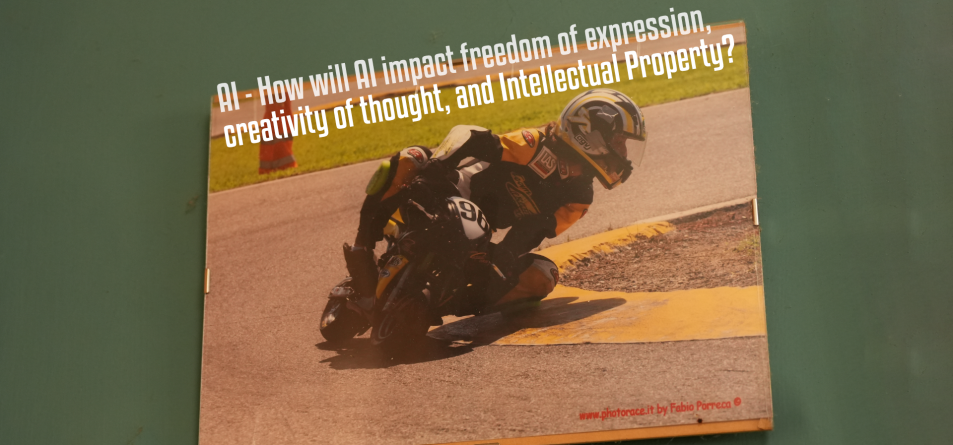
AI – How will AI impact freedom of expression, creativity of thought, and Intellectual Property in the Media landscape? As Artificial Intelligence has transformed data analysis to improve work-flow efficiencies, production of visual and written content has transformed how viewer’s, fans, and follower’s engage with sport athletes and racing action.
Roberta Ponziani shares her thoughts on working at her family’s bakery – Bocconotto Reale – along with racing World WCR 2025. Film: MXLink.
Undoubtedly, AI has stream-lined the processing of information on market demand of content prompting allocation of resources to production of Media content on specific rider’s/driver’s at the track. Based on strategic decisions to increase audience engagement across generations and gender, AI has the capabilities to pin point areas to up-scale marketing and promotion of visuals to enhance fan experience, both online and at the track.
Such response to data available operates without the need to take into account differences of opinions or freedom of choice on delivering content which opens dialogues on how rider’s/driver’s face and overcome challenges to race. When results are unpredictable, uncompromising of error, and unforgiving of mistakes, the camera operator and journalist acts from experience and instinct – knowing how to capture the frailty of racing – man vs machine – which is neither driven by analytics nor AI generated data.

Most certainly, AI has the metrics to identify content which boosts audience retention from producing stats on rider/driver performance to the incredibly quick processing time of images and film clips into reels pre-during and post racing. A case study of Formula One photographers highlights how AI has the capacity to significantly reduce the laborious task of scrolling through 1000’s of images by selecting those of most interest for a market audience, enabling time for further editing.
These ultra efficient work processes however, negates the input of creativity of thought on deciding what to film, who to interview, and how to capture moments which are unique to the rider/driver and event. Covering women racing The Dakar Rally in situ remains incredibly expensive and time consuming given the race goes for 14 days and covers over 9,000kms in Saudi Arabia. Such obstacles should not prevent production of content, rather provide motivation to find work around solutions to share these career defining achievements to a global audience. In the case of covering Spanish rider – Sara Garcia – competing in The Dakar Rally Unassisted Bike category in 2021 – direct messages via What’s App at the half-way stage enabled MXLink to up-date reader’s on Sara’s grueling race, in real-time.
Courtney Duncan shares her thoughts on racing WMX on debut in 2016. Filming: MXLink at Assen GP in 2016.
AI’s proficient development of tools and resources to access information gains leverage from ideas, images, and visuals captured by creatives in the past to the present day. These founding pieces of work – photographs, documentation of career results, films of historical significance, along with IT visuals provide a base-line upon which AI re-defines to broaden scale and scope of use. AI places a new narrative on content which has been supplied – and therein blurs the lines between creatives Intellectual Property rights and content re-generated for the consumer.
The protection of Intellectual Property has long been a source of contention even when copyright infringements are in place. The comparative ease by which software can tweak, modify, cut, and mis-represent images and films not only prompts viewer’s to question the authenticity and originality of the piece of work but also raises awareness on ethical codes and standards on the production of content. For creatives, action to protect work from manipulation – either by AI generative content or online scammers – remains as disruptive as ever.
Header photo: Roberta Ponziani photo taken at her family’s bakery – Bocconotto Reale, near Teramo, Italy, 2025. Image: MXLink.
Words: Sharon Cox.


Comments are closed.