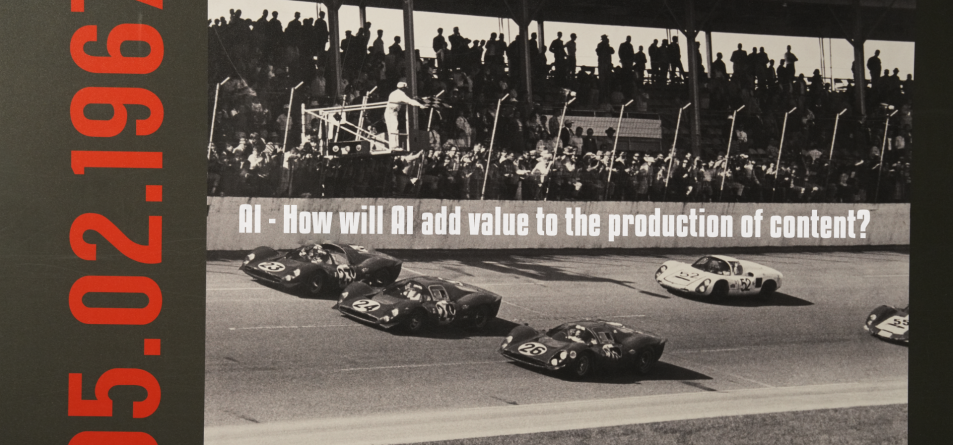
AI – How will AI add value to the production of content? As Artificial Intelligence proves an efficient resource for transforming the landscape of productivity in business, service industries, product marketing, and research, the value added to each segment of production remains dependent on the sustainability of work-flow processes which relies on demand meets or exceeds supply in a consumer market driven by customer choice.
NZ’s Chris Amon raced in Formula One with Ferrari in 1967 – 1969 taking 3rd placed podiums in Formula One Monaco GP, Belgian GP, British GP, and the German GP finishing his debut season 5th overall in the Championship. Chris and Lorenzo Bandini won 24 Hours of Daytona and Monza 1000kms in 1967. Article: https://mxlink.co.nz/the-fantastic-success-of-chris-amon-bruce-mclaren-and-denny-hulme-in-24-hours-le-mans-1966-ford-vs-ferrari-and-what-this-means-for-racing-today/
Within the Media industry, AI has added value by reducing time on image and film editing, consolidating information of rider’s/driver’s career highlights and results, as well as outlining career pathways for those interested in race/car data analysis, engineering, IT, and the all important social media marketing posts. Most definitely, AI does not operate bias of gender, class, or generational preference for work opportunities, rather information provided remains objective and open for personal interpretation.
Such was the case when researching images and film clips on New Zealand’s Chris Amon who raced Formula One seasons with Ferrari from 1967 – 1969. Piecing together archive material at Ferrari’s museum’s at Modena and Maranello provided up-close-and-personal experience on the evolution of the iconic Brand, including Amon’s achievements of 3rd podiums in his first season. AI generated information could of provided insight on how Chris’s results aligned with Ferrari’s production line of car’s – which were competitive both in Europe and the USA at the time.
Film on Roberta Ponziani prior to racing World WCR at Jerez, Spain in October. Filmed at Autodromo dell’Umbria circuit in Magione and at her family’s bakery near Teramo. Film: MXLink.
Notwithstanding AI capabilities of adding value to research projects, AI falls short on creating story-lines which reveal the passion, drive, and determination rider’s/driver’s possess to pursue a career in Motorsport. Capturing such emotive elements requires open dialogues between the creator and athlete, questioning how each tackles the load of training, work, sponsor obligations, racing, along with time with family and friends – defining what to film, where and with whom.
All of which speaks volumes on how film producer’s and writer’s work with sincerity to honor and respect the people they are filming. Most certainly, the opportunity to film a story on Italian World WCR – Roberta Ponziani – at her family’s bakery of Bocconotto Reale – was truly special and a privilege. From the open invitation to interview Roberta inside the bakery, to filming her working with time-treasured machines mixing the biscuit dough then placing the trays in the ovens, not only shared Roberta’s daily life with viewer’s and fans, but also revealed the importance of family in Roberta’s quest for racing podiums. Such insight does not fit within AI’s model of adding value, yet proved far more in terms of worth to Roberta and family, and all eyes watching.
Header photo: Chris Amon winning Monza 1000kms with Lorenzo Bandini in 1967 with Ferrari Image: MXLink taken at Ferrari museum at Maranello.
Words: Sharon Cox.


Comments are closed.